
N Chandrasekaran, chairman of Tata Consumer Products, has said in the company's annual report for FY25 that India remains one of the bright spots of economic growth amid a volatile global environment. He said India's long-term growth was underpinned by strong demographic and economic fundamentals as well as structural reforms.

Foreign investors have made a strong comeback to Indian equities with a net investment of Rs 22,766 crore in the first two weeks of December driven by expectations of rate cut by the US Federal Reserve. This revival follows significant outflows in the preceding months, with Foreign Portfolio Investors (FPIs) pulling out a net Rs 21,612 crore in November and a massive Rs 94,017 crore in October -- the worst monthly outflow on record.

Pointing out that loosening cycle of monetary policy by RBI began only in October, Moody's said, it might not have led to an immediate rebound in domestic consumption. However, the RBI on Thursday stated that monetary measures taken by it were 'appropriate'.

The 25 per cent US tariffs, plus a penalty for Russian imports, could dent India's GDP growth by 30 basis points in the current fiscal, but the higher duty is unlikely to significantly affect India's domestic demand-driven economy, Barclays said on Thursday. If the 25 per cent tariff, announced by US President Donald Trump on Wednesday, is implemented from August 1, the effective average US import tariff on Indian goods will rise to 20.6 per cent in trade-weighted terms, as per Barclays estimates.
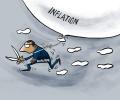
'If all goes well, we may well hit or even surpass the forecast growth rate.'

The Reserve Bank of India has also expressed concern over rising inflation and said the prevailing level is above its comfort zone.

The three day MPC meeting began on Monday and the decision will be announced on Wednesday by RBI Governor Shaktikanta Das.

The Indian economy is projected to grow at 6.2 per cent in 2025-26, slower than earlier estimated rate of 6.5 per cent, due to escalated trade tensions and global uncertainty, the International Monetary Fund (IMF) said on Tuesday. "For India, the growth outlook is relatively more stable at 6.2 per cent in 2025, supported by private consumption, particularly in rural areas," IMF said in its World Economic Outlook (WEO).

India's economic growth forecast for 2025 has been revised downward to 6.3 per cent, and despite a projected moderation, the country remains one of the fastest-growing large economies, supported by resilient consumption and government spending, the United Nations has said.
The central bank's next monetary policy review is scheduled for April 5. It had kept the policy rate unchanged in its February meeting on fears of inflation.

The RBI's policy decision would be the major event driving trading sentiment in the equity market this week, while global cues, foreign funds movement and crude oil prices will be the other key factors to watch out for, analysts said. Markets have been witnessing a rebound recently. However, the move lacks decisiveness amid lingering challenges like global policy tightening due to soaring inflation and geopolitical tensions, they added. "RBI policy, global macro numbers and crude oil prices will set the trend for this week.

India has opposed the International Monetary Fund's (IMF) proposal to extend fresh loans of USD 2.3 billion to Pakistan, citing concerns that the funds could be misused for financing state-sponsored cross-border terrorism. India abstained from voting at the IMF meeting, expressing concerns about Pakistan's track record and the possibility of debt financing being misused for terrorism. The IMF took note of India's statements and its abstention from the vote. India's opposition comes at a time when military conflict between India and Pakistan has intensified following a terrorist attack in Kashmir.

While India won't be immune to global spillovers, we need to create the macro preconditions for sustained growth. Policy agility, prudence, and resilience will be key, suggests Sonal Varma.

'But this Budget alone will not fix what ails the Indian economy.'

After delaying liberalisation for foreign banks by over a year due to global financial meltdown, the Reserve Bank on Tuesday decided to review its position by September this year in the wake of improving conditions worldwide.

RBI had made available a potential liquidity of Rs 5.60 lakh crore (Rs 5.6 trillion), nearly 9 per cent of gross domestic product, to help the country tide over the liquidity crisis following the global financial meltdown triggered by the collapse of America's iconic investment banker Lehman Brothers in mid-September.
Indian capital markets joined the global sell-off sparked by China growth concerns
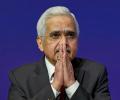
Outgoing Reserve Bank Governor Shaktikanta Das said on Tuesday that restoring inflation-growth balance is the most important task ahead of the central bank. Addressing a press conference on his last day as the central bank chief, Das said his successor will have to navigate the changing world order, effectively deal with cyber threats, and focus on harnessing new technologies.

The US Fed interest rate decision, ongoing quarterly earnings, macroeconomic data and FII trading activity are the major triggers that will drive stock markets this week, analysts said. Investors would also track global market trends and the movement in global oil prices for further cues. "This week, the focus will shift to global cues, particularly the US markets," Santosh Meena, Head of Research, Swastika Investmart Ltd said.

The Survey is authored by Chief Economic Advisor V Anantha Nageswaran and his team.

Prospects of a bumper kharif harvest are expected to lower food inflation in the coming months, making the country's inflation outlook benign, the Union Ministry of Finance (FinMin) said in its monthly economic report for October released on Monday.

Gold future prices sustained upward trend for the fourth straight session by surging Rs 2,048 to hit a fresh record high of Rs 100,000 per 10 grams as investors rushed to safe havens after US President Donald Trump indicated plans to overhaul Federal Reserve amid continuing global trade war jitters. On the Multi Commodity Exchange (MCX), the August delivery contract of the yellow metal bounced by Rs 2,048 or 2.1 per cent to hit a fresh peak of Rs 100,000 per 10 grams in the mid-session trade.
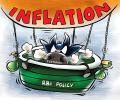
The RBI's Monetary Policy Committee brainstormed the impact of any future shocks on the inflation trajectory and stressed monitoring the cumulative effect of monetary policy actions over the past one year, which is still unfolding, revealed minutes of the rate-setting panel released on Thursday. The minutes of the meeting of the Monetary Policy Committee (MPC), headed by Reserve Bank Governor Shaktikanta Das, also indicated it would be premature to declare an end to the monetary tightening cycle, which started in May 2022 to check high inflation following the outbreak of the Russia-Ukraine war. The central bank, which effected six back-to-back hikes in the key short-term lending rate (repo) since May 2022 to check high inflation, decided to take a pause early this month.

United States President Donald Trump on Tuesday said India has not been a good trading partner and announced that he will raise the tariffs on New Delhi 'very substantially' over the next 24 hours because it is buying Russian oil.

India has decided to submit a dossier at the upcoming Financial Action Task Force (FATF) meeting, calling for Pakistan to be placed back on the grey list of the global money laundering and terrorist financing watchdog.

It is time for India to raise its voice not just through military prowess, but through professionalism, principled voting and partnerships, asserts Deepak Mishra.

Donald Trump's tariffs, meant as political punishment, have avoided the predicted chaos, lifting US growth, weakening rivals, and letting him claim victory in a resilient global economy, observes T T Ram Mohan.

From the 30 Sensex firms, Tata Steel, JSW Steel, Power Grid, HDFC Bank, Tata Motors and Larsen & Toubro were the biggest gainers. Hindustan Unilever, Infosys, Bajaj Finance, Axis Bank, Kotak Mahindra Bank and UltraTech Cement were among the laggards.
Wholesale price based inflation declined to a 3-month low of 1.89 per cent in November on cheaper food items, and experts predicted a 0.25 per cent interest rate cut by the RBI in the policy review in February. The Wholesale Price Index (WPI) based inflation was 2.36 per cent in October 2024. It was 0.39 per cent in November, last year. In August, 2024, it was 1.25 per cent.

'Helicopter drop' was first proposed as an alternative to quantitative easing.

'With China falling out of favour, India is where investors see the demographic and digital dividend apart from the benefits of reforms playing out.' 'Your prime minister has also done a great job of sharing this story with the world.'

Reserve Bank of India (RBI) Governor Sanjay Malhotra on Wednesday said regulations should not create unintended barriers to financial inclusion while emphasising that the impact of regulations on individuals and businesses should be considered.

From the Sensex pack, Adani Ports & Special Economic Zones, Mahindra & Mahindra, Reliance Industries, HDFC Bank, Larsen & Toubro, NTPC, State Bank of India, UltraTech Cement and Kotak Mahindra Bank were the major gainers. In contrast, Tata Steel, Titan, Bajaj Finserv, JSW Steel, Bajaj Finance, Hindustan Unilever, ITC, Tata Motors and Tata Consultancy Services were among the laggards.

From the 30 Sensex firms, Mahindra & Mahindra, JSW Steel, Maruti, Tata Steel, Larsen & Toubro, ICICI Bank, Power Grid, Nestle, Bharti Airtel and Adani Ports were the biggest gainers. Tata Consultancy Services emerged as the only laggard.

All sectoral indices ended lower. BSE Telecommunication tanked 2.18 per cent, metal (1.77 per cent), auto (1.70 per cent), energy (1.64 per cent), oil & gas (1.59 per cent), commodities (1.39 per cent) and financial services (1.37 per cent) were the major laggards.

Union Finance Minister Nirmala Sitharaman on Monday said people are finding current interest rates "very stressful" and urged banks to make them affordable. Speaking at an event organised by State Bank of India, the finance minister said that at present, India requires industry to ramp up and invest in new facilities, and added that lowering lending rates can help achieve the "Viksit Bharat" aspiration.

Three members will be representatives from the government, and three from the RBI.

The Reserve Bank of India's interest rate decision, domestic macroeconomic data and global trends will dictate terms in the equity markets this week, analysts said. Trading activity of Foreign Portfolio Investors (FPIs) will also influence markets, they added. "The Indian market will be closely monitoring the Reserve Bank of India's Monetary Policy Committee (MPC) meeting scheduled for June 6-8, 2023. Aside from that, market participants will be keeping an eye on the progress of monsoon," said Pravesh Gour, Senior Technical Analyst, Swastika Investmart Ltd.

India registered its protest at the board of IMF, which met on Friday to review the EFF lending programme for Pakistan.

Among the Sensex constituents, 20 stocks ended the session in green with HDFC Bank, Titan, Tech Mahindra, and Asian Paints being the major gainers. TCS, Maruti, Kotak Mahindra Bank and Bajaj Finserve were the other gainers. In contrast, SBI, Bharti Airtel, JSW Steel, PowerGrid, ITC and Reliance closed the trading with losses.
